
Plant a tree and most people applaud. Propose one near a driveway, a fence line, or a bushfire-prone ridge, and the room can divide. Despite decades of evidence linking trees to health, cooling, wildlife, and carbon storage, tree decisions still provoke resistance. A 2025 Land review argues that the real issue is often ambivalence rather than outright opposition. An eastern Australian survey found strong awareness of tree benefits, yet concerns clustered around root damage to infrastructure, property damage, and injury from falling branches.
This tutorial examines why some people hate trees through historical, cultural, practical, and psychological lenses, including the Australian rural context of culture, fire, and an honest evidence gap. It also looks at what people actually value about trees and offers a design-led framework for engaging reluctant stakeholders. You will learn how to start with the objection, walk the site together, offer options, design removal and replacement into the plan, agree on maintenance and risk early, and use co-design across project types. The goal is not to win an argument about trees, but to build decisions that last.
Why Tree Decisions Split a Room
Tree decisions rarely split a room because one side loves trees and the other hates them. A 2025 review in Land, Addressing Ambivalence to Promote Climate Resilience, frames public attitudes as ambivalence rather than opposition: most people hold the benefits and the risks at once.
Information is rarely the sticking point. An eastern Australian survey found high community awareness of tree benefits, so disagreement usually turns on placement, species, cost or risk rather than whether trees matter at all.
And the losses are real. A root lifting a driveway, a limb through a shed roof or a valued view closed off by a maturing canopy are genuine costs, not misunderstandings. Naming them first is what makes any later case for planting credible.
What follows examines tree conflict through four lenses, historical, psychological, practical and cultural, then sets out a design led engagement framework that transfers to any project type, from a suburban extension to a staged depot masterplan where mature trees survive construction.
It is written for regional Western Australian homeowners, community groups, farmers and small businesses, and for the architects, planners, landscape designers and shire staff who facilitate these conversations.
Trees Have Always Been Argued About: Conflict Is Not New
This discomfort has pedigree. In 1876 Frederick Law Olmsted proposed Central Park as a forestry laboratory, a museum of arboriculture arranged for profitable study and for persuading a public that had to be brought along. The thinning that followed drew vehement opposition anyway. His answer was telling: he co-wrote ‘Observations on the Treatment of Public Plantations, More Especially Relating to the Use of the Axe’, a document as concerned with managing public feeling as with managing trees.
In 1891 he hired Gifford Pinchot to establish the Biltmore Forest, a milestone that became the birthplace of professional forestry in the United States. So the discipline did not grow out of calm consensus. It grew out of contested ground, on degraded hillsides, with arguments running inside the profession as well as outside it.
United States Forest Service research is blunt about the pattern: applying silviculture to forests in cities “has long been met with resistance”, and public sentiment stays protective of trees even where treatment would improve tree health.
Removal, not planting, remains the under studied side of urban forestry. Trees come out daily for functional, aesthetic and logistical reasons. Saying that plainly matters to anyone who feels their objection is being dismissed as ignorance.
The lesson for 2026 is simple. Tree conflict is a recurring design problem with a long history, not a personal failing in the person sitting across the table. The psychology behind it is the next lens.
Ambivalence, Not Opposition: The Psychology Behind Tree Resistance
History explains why tree conflict recurs. Psychology explains why it persists within a single conversation.
Ambivalence is the more accurate frame. The same person can value shade, birdlife and property value while genuinely fearing damage, cost and loss of control, and both feelings can surface together without contradiction.
Australian research on public satisfaction with urban trees links satisfaction to canopy cover and visibility around the home, not knowledge alone (Satisfaction with urban trees). Cultural identity shapes perceived value too: Melbourne research found diverse cultural identities influence how urban forests are valued (Cultural identities and urban forests). The practical lesson is that trust and prior experience carry as much weight as information. Another fact sheet rarely shifts a position. A relationship, a site visit and a kept promise often do.
Loss aversion matters here. A tree is long lived and hard to move, prune or remove, so resistance frequently expresses a wish to stay in charge of a place someone owns rather than a rejection of nature. Trees also carry memory and identity: one removed in childhood, a fire scar, a view that framed a family home, or a species tied to a neighbour’s dispute. Foundational research on urban forest values describes these attachments as approaching spiritual involvement, bound to tradition and symbolism (Significance of urban trees and forests).
So ask what the tree means and what it has cost before arguing what it does for the environment. That question leads directly into the practical concerns behind most objections: roots, limbs and liability.
Root Damage, Falling Branches and Other Practical Fears
The Concerns Are Real and Well Documented
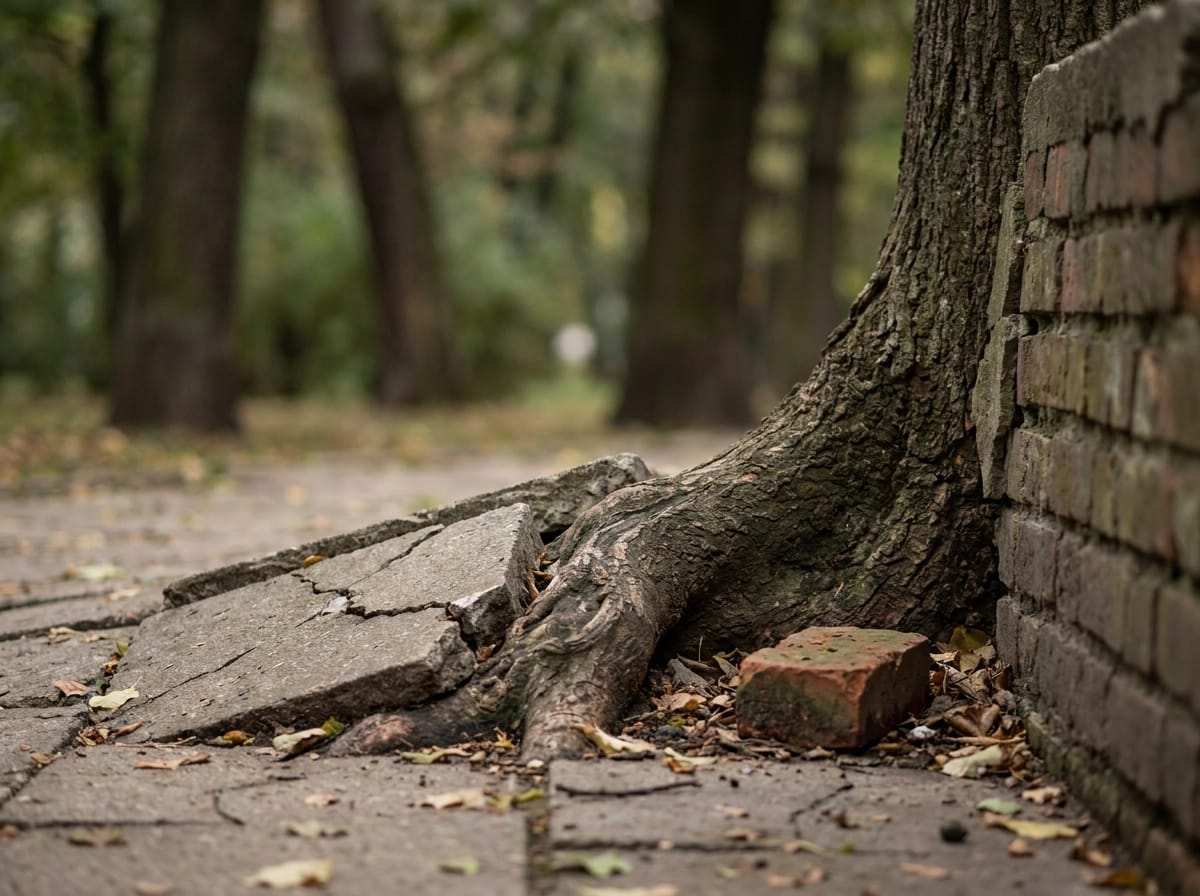
An eastern Australian survey found community worries concentrated primarily on root damage to infrastructure, property damage and injury from falling branches. In regional Western Australia, that translates into specific assets: septic tanks and leach drains, water and power lines, driveways, house footings, sheds, fence lines, verge paving and drainage lines. The symptoms are concrete, including cracked brickwork, uneven paving, leaning fences and blocked drains.
Why the Fear Outweighs the Benefit
Risk perception is not arithmetic. A limb through a roof is rare but vivid and memorable, and it shapes attitudes far more than an annual benefit such as summer shade.
Cost, Liability and Maintenance Fatigue
Someone must pay for pruning, and someone carries responsibility if a limb falls. Where a large tree sits near a boundary, insurers and neighbours both take an interest. Claims after a storm follow documented insurance pathways, and outcomes differ depending on whether the tree stood on public or private land, so confirm expectations before damage occurs. Maintenance fatigue is quieter but just as real: ageing residents, absentee landholders and labour shortages in farming districts all raise the question of who does the work in twenty years.
Every Fear Has a Technical Answer
Each concern reframes as a design problem: root barriers, setbacks from services and footings, clearances from powerlines, species selection, staged planting and documented inspection schedules. Sound landscape design in WA treats these as specification decisions rather than compromises. Handled this way, the objection becomes a constraint the plan can answer.
Trees in Regional Australia: Culture, Fire and an Honest Evidence Gap
Those practical fears carry a cultural layer that is often missed. Before we make any general claim about Australian attitudes, the evidence caveat matters: the Australian studies reviewed here are urban and sub tropical, drawn from Sydney and Melbourne local government areas, and none cover regional or rural attitudes. Do not extrapolate them to regional Western Australia.
The clearing inheritance runs deep. Colonial ringbarking, closer settlement and land clearing shaped a landscape read as productive only when open, and that inheritance still shapes how some families read a treed paddock.
Aboriginal cultural burning offers a different relationship to fire and country altogether: vegetation managed with fire rather than removed to avoid it. On bushfire, the only reference in the evidence reviewed is a perceived benefit, reported by residents as protection from bushfires. That sits awkwardly beside risk concerns and must be treated as site specific and locally advised.
Farming trade-offs are genuine. Shelterbelts and windbreaks, salinity and erosion control, and stock shade and shelter compete with pasture competition, fence damage and machinery clearance. For many landholders this is a practical calculation, not an attitude problem, and it belongs in Landscape by Design thinking from the start.
Regional observations in this article come from the practice experience of an accredited regional Western Australian practice and are labelled as such, not presented as cited research.
What People Actually Value About Trees
When an eastern Australian survey asked residents what trees gave them, the answers were practical: shade and heat reduction, native species attracting wildlife, connection with nature, carbon storage, aesthetics and food production.
One entry surprises rural readers. Protection from bushfires appeared in the survey as a valued benefit. Treat it as site specific and locally advised rather than a general claim, but it is a useful conversation opener in regional Western Australia.
Notice the pattern in rejection. People rarely object to trees as a category; they object to a species, a placement or a maintenance load. Human choices, not ecology alone, drive low diversity in planted landscapes. The same decisions that frustrate a resident can be redesigned.
So lead with the benefit the person already wants. Shade over a parked car. A windbreak for stock. Privacy from a neighbour. Birdlife outside a kitchen window. Start where they are, then widen the case.
That reframing sets up the engagement framework that follows.
A Design Led Framework for Reluctant Stakeholders
What follows is practice guidance from an accredited regional Western Australian practice, not cited research. We say so openly, because the framework reflects our own project experience across residential, community, commercial, heritage and landscaping work rather than a published study.
The six principles work in order, and they scale. A single homeowner with one contested verge tree, a community committee, a farm plan or a commercial client can all use the same sequence; only the level of detail and the number of people at the table change.
The goal is a workable, agreed landscape, not victory in an argument about trees. A stakeholder who chooses the compromise will maintain it; one who loses the debate will not.
Begin at concept stage, before a plan has been drawn and has to be defended. Western Australian planning policy already frames tree preservation as a front-end process, and once a layout exists, any concession feels like retreat. Early engagement is simply better design, consistent with designing with you rather than for you.
Start With the Objection, Not the Benefits
Principle one runs against instinct, because every impulse says to explain the benefits first. Instead, ask a question: what has a tree cost you, or cost someone you know?
Then write the answer down and read it back accurately. Agreement on the problem builds more trust than agreement on the solution ever will.
Choose your words carefully. Terms like myth and misconception tell a person their experience is wrong, and the conversation closes. A concern named as a risk that can be managed stays workable. The same careless labelling does damage elsewhere in the built environment, where the persistent myth that architects only serve wealthy clients still keeps people from asking for help.
Finally, convert each objection into a design constraint with a stated response. “Roots lifting the driveway” becomes a four-metre setback, a root barrier and a species chosen for non-aggressive roots. The stakeholder watches their concern shape the plan, which is the point.
That written constraint is what you take to the site visit.
Walk the Site Together Before You Draw
Once the objection is on paper, go outside. Time the visit to the conditions the stakeholder complains about: late afternoon summer heat, low winter sun, prevailing wind, or a fire weather day. Standing in the problem persuades more than describing it.
Walk the boundaries and name what constrains any planting: services, easements, drainage, sight lines, powerlines, and the expectations of neighbours and the shire. Settle these before species enter the conversation.
Sort existing trees into assets, liabilities and genuine current hazards. A leaning tree is not automatically a hazard, so where risk, heritage value or significance is in question, commission an arborist’s report. Note clearance and setback requirements too, applying the same logic that governs how to plan outdoor storage in regional WA.
Then hand over the marker. Let the stakeholder draw the trees they want kept, the ones they would remove, and the views they want protected. Choosing what stays reduces the sense that a decision is being made for them, and the marked-up map becomes the first shared document of the project.
Offer Options Instead of a Single Plan
Once the map is marked, bring three costed layouts rather than one defended plan: full retention, staged replacement, or no new tree with a structural alternative such as a pergola, shade sail or screen planting.
Price each option fully, not just the plant. Itemise establishment, watering through the first two summers, formative pruning, periodic arborist inspection and eventual removal. Obtain local quotes; unit costs vary by shire and site access.
State the trade-offs plainly. Full retention buys mature shade and habitat but carries branch risk and higher maintenance. Staged replacement spreads cost and maintains canopy continuity, yet accepts years of small trees. A pergola or screen planting gives immediate shade or privacy with predictable upkeep and no canopy at all. Short-term cost against long-term canopy should be named, not buried.
Then hand the decision back: ask which option they want to live with. People accept outcomes far more readily when they have chosen them, the same early discipline behind designing to save construction costs before you break ground.
Design Removal and Replacement Into the Plan
It is worth saying plainly: trees come out of landscapes every day for functional, aesthetic and logistical reasons. Removal is the under-studied side of urban forestry, and treating it as failure only makes the conversation harder. Plan for it.
Build succession into the design rather than relying on one planting event. Combine shorter lived and long lived species in staged plantings so canopy cover never drops to zero on site. Short lived species are not a compromise; they buy early shade and habitat while slower specimens establish. As Western Australia’s urban landscape continues to change, that shift is worth understanding before you specify.
Specify the technical detail at documentation stage: root management, setbacks from footings, drains and services, and clearances from powerlines and buildings. Then select species that match local wind, salt, soil, frost and fire conditions rather than whatever the nursery has in stock this season.
Agree on Maintenance, Risk and Responsibility Early
Removal and replacement planning only holds if someone is accountable for what stays in the ground. Before planting, document who prunes, who inspects, how often, and at whose cost. Where a tree sits on a verge or shared land, confirm the shire’s position in writing first, including any permit requirements.
Large or hazardous trees need a set inspection interval and a written trigger for review after storms, cyclones or fire. Unspecified intervals are what leave risk unmanaged.
Settle insurance and liability expectations before planting, not after a limb falls. This matters most where a tree sits near a boundary or overhangs a building, where responsibility is often assumed rather than agreed.
Finally, include a plain-language maintenance schedule in the handover. A simple table of tasks, seasons and contacts is enough for an owner or committee to follow. Agreed responsibility early prevents the dispute that otherwise arrives with the first dropped branch, and it sets up the co-design approach covered next.
Learn While Doing: Co-Design Beats Top-Down Targets
With responsibilities settled, shift the planting itself to a staged trial. Research has moved away from top-down planting targets towards co-designed, experimental, learning-while-doing approaches developed with the people who manage the land. Local knowledge about wind, frost, salty bore water and who actually holds the hose belongs in the design.
Plant one section first, then monitor survival and the real maintenance load before extending what has worked. Review at six and twelve months. Adjust species, placement and irrigation according to what lived through the first summer, rather than what the plan assumed. Recording failures openly builds more credibility than defending a planting schedule.
Treat engagement as a design skill, not an obstacle. Conflict and collaboration in urban forest management is now a recognised field of study, which confirms what practitioners already know: the conversation is part of the work. A plan that a committee or family has helped test will outlive one imposed on them, and that habit scales to any project size.
Applying the Framework Across Project Types
Co-design principles hold across project types. What changes is the decision-maker, the site’s risk profile and the life of the asset.
- Residential. New homes, extensions and bushfire prone lots, where a single tree decision often sits inside a thirty-year maintenance plan. Design for who prunes it in 2056, not just for the first summer.
- Community. Schools, sporting clubs, memorial plantings and shire verges, where committees decide and whole communities remember the outcome. Record the decision and the maintenance commitment so both outlast a change of committee.
- Commercial. Car parks, street frontage and worker amenity, where clear maintenance budgets and liability arrangements matter more than a planting statement. Cost these at concept stage.
- Heritage. Mature trees are often both the character contributor and the binding constraint. Check local heritage and planning controls before any removal or significant pruning.
- Landscaping. Verge plantings, windbreaks, screens and productive trees form the practical toolkit. Size each to the client’s real appetite for watering and pruning, not the ideal one.
Across all five, the pattern is the same: name the decision-maker, cost the maintenance, and confirm the controls. Office of Regional Architecture facilitates contested sites, with experience across residential, community, commercial, heritage and landscaping projects in regional Western Australia.
Answering Common Questions About Trees and Design
The same questions surface in almost every contested tree decision. Short answers follow.
Why do people object to trees? Documented concerns concentrate on root damage to infrastructure, property damage and injury from falling branches, alongside maintenance burden, cost and loss of views.
How do you bring a reluctant client around? Start with their objection rather than the benefits. Walk the site together, offer two or three options with real costs attached, and agree maintenance and risk responsibility up front.
Does more information change minds? Rarely on its own. Australian research on public satisfaction with urban trees shows trust, values and prior experience shape acceptance as much as knowledge does.
Can trees reduce bushfire risk? In the evidence reviewed, protection from bushfires appeared as a benefit reported by residents. The answer is site specific, so take local fire and planning guidance before deciding.
Do I have to keep every tree? No. A staged replacement, a smaller species or a structural alternative such as a pergola or shade sail can deliver the benefit without carrying the risk.
The section that follows turns these answers into a working method.
Bringing a Reluctant Stakeholder On Board
The principles matter less than the sequence. Five takeaways carry most of the weight.
Assume ambivalence, not opposition. Most people hold the benefits and the risks at once. Start from what they already value, whether that is shade over a parked car, a windbreak for stock or privacy from a neighbour.
Ask before you argue. Ask what a tree has cost them, or cost someone they know. Then write that concern into the plan as a stated design constraint, so they can see it influencing the outcome.
Walk the site together, at the time of day or season the problem actually occurs. Let the stakeholder mark the plan themselves. Choosing what to keep reduces the sense that a decision is being made for them.
Bring two or three costed options rather than one defended plan. Price establishment, watering, pruning, inspection and eventual removal. Include replacement and maintenance in the thinking from day one.
Agree responsibilities in writing: who prunes, who inspects, who pays, who is liable. Include the shire’s position for verge or shared land. Review at six and twelve months, then adapt species, placement or irrigation based on what survived the first summer.
If you are working through a contested site in regional Western Australia, the team at Office of Regional Architecture can help you walk the site, test the options and facilitate the conversation with everyone at the table.
Conclusion
Tree decisions do not have to split a room. Start by assuming ambivalence, not opposition. Ask what trees have cost people, then treat those concerns as real design constraints. Walk the site together, offer two or three costed options, and agree who prunes, inspects, pays, and is liable. That sequence builds trust and better places.
The value is not just fewer objections. It is a plan people understand, can maintain, and will live with through hot summers and long years. If you are facing a contested site, gather the right people, test the options, and adapt as you learn.
Ready to move from conflict to co-design? Contact Office of Regional Architecture to walk the site, facilitate the conversation, and help your stakeholders find a way forward together.