
Specifying landscape materials in Western Australia has never carried more consequence. As the profession moves beyond vague sustainability claims toward measurable, carbon-conscious decision-making, the choices made at the specification stage now shape project outcomes in ways that extend far beyond aesthetics or budget. Western landscape supplies are no longer simply a procurement category; they are a statement of professional responsibility.
This guide is written for practitioners who already understand the basics and are ready to go deeper. Drawing on emerging international precedents, the evolving guidance of the Australian Institute of Landscape Architects, and the growing role of Environmental Product Declarations in material selection, it covers the full sourcing spectrum. You will find practical direction on stone, timber, reclaimed materials, soil media, recycled aggregate, and native planting, alongside a clear explanation of how EPDs should be used in WA practice.
Whether you are specifying a regional streetscape or a large-scale ecological restoration, the sections ahead will help you source materials that are traceable, lower in embodied carbon, and genuinely suited to the Western Australian context.
Why Material Sourcing Decisions Matter More Than Ever in WA
Material specification in landscape architecture has moved beyond good intentions. Environmental Product Declarations (EPDs) are now described as “critical to decision-making” by leading researchers including Meg Calkins, Professor of Landscape Architecture at North Carolina State University, whose forthcoming book on carbon-positive material assemblies signals where the profession is heading. Growing professional expectations, reflected in international bodies and increasingly in AILA guidance, mean broad environmental language no longer satisfies specifiers or clients.
The benchmark has also shifted. Carbon neutral is no longer the ceiling. Carbon-positive design, where landscapes actively remove more carbon than construction emits, is the emerging standard that credible practice now targets.
For regional WA, the stakes are higher than elsewhere. Supply chain distance from metropolitan centres means transport-related embodied carbon can materially alter a project’s total footprint. Local sourcing is not a preference; it is a functional sustainability lever. Like any design discipline, responsible material specification is ultimately a problem-solving exercise, one where geographic constraints sharpen rather than limit the quality of decisions.
The timing of specification matters enormously. Research confirms that approximately 90% of a constructed site’s carbon footprint derives from the materials used to build it, not from ongoing operational energy. For residential clients, community builds, and heritage projects alike, choices locked in at specification stage are difficult and costly to reverse once construction begins.
Stone and Gravel: Prioritising Local Quarry Sources
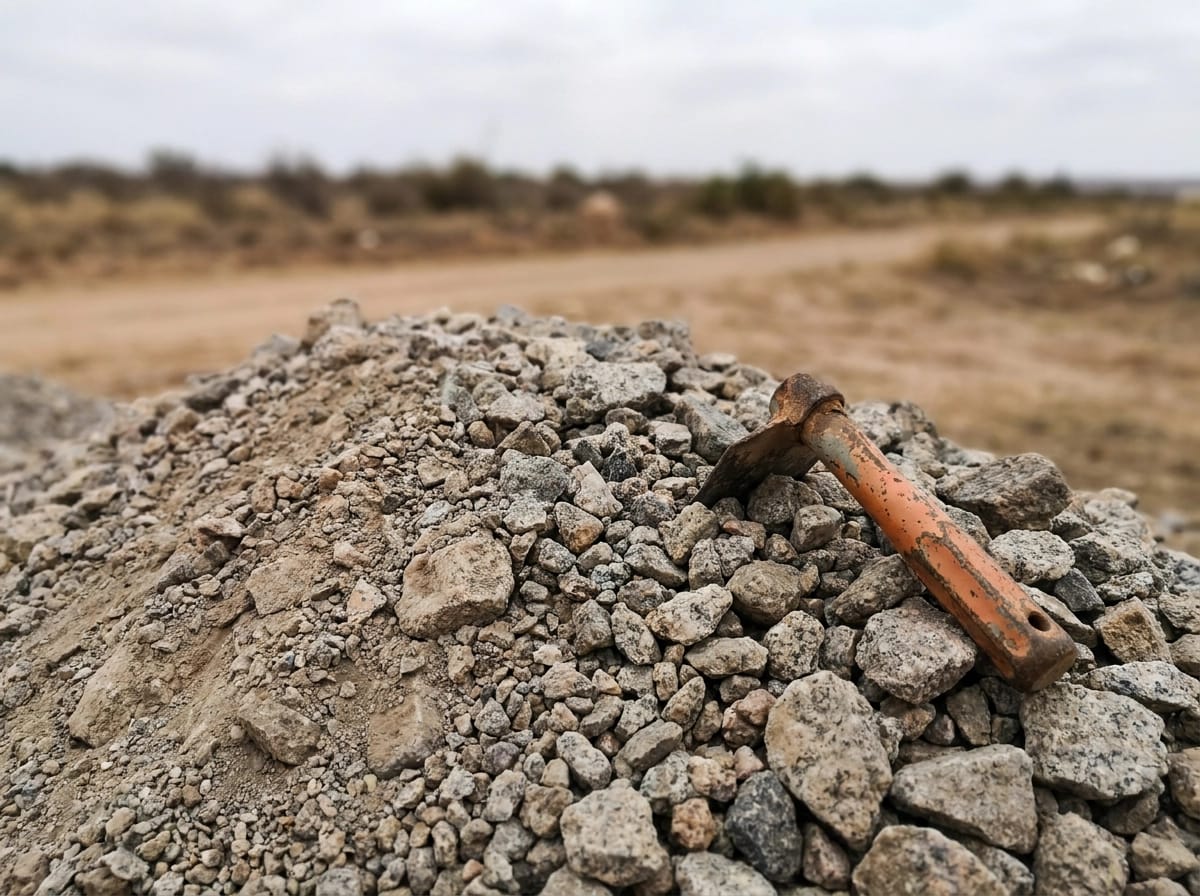
Stone and gravel sourcing is where transport-related embodied carbon becomes most visible in regional WA projects. Embodied carbon projections for Australian infrastructure confirm that material origin materially affects a project’s total carbon footprint, making local quarry specification a functional decision, not just a preference.
Regional WA is home to established quarrying operations — specifiers should confirm local quarry availability with suppliers at brief stage. Specifying locally quarried limestone, granite, or laterite gravel avoids transport-stage emissions incurred when importing from eastern states or overseas. Scottish granite carries approximately 92.9 kgCO₂e per tonne cradle-to-gate; Spanish granite reaches 164.3 kgCO₂e per tonne, with transport accounting for a significant share of the difference.
Laterite (ironstone gravel) is found across parts of regional WA and is worth investigating as a locally sourced permeable surface option; confirm availability and load-bearing suitability with local suppliers.
EPDs for quarried stone are becoming more available through Australian suppliers. Request documentation directly from local quarries; where Australian data is absent, cross-reference international EPD databases as an interim measure.
Reclaimed stone from demolished farm buildings, homesteads, and dry-stone walls is worth seeking out on heritage projects, where it also carries material continuity with genuine cultural value.
For retaining walls or feature walls, confirm load-bearing suitability and frost resistance alongside environmental credentials. Frost resistance is a live consideration in higher-altitude regional areas and should not be assumed.
Timber: Certified, Reclaimed, and Locally Milled Options
Timber follows the same logic as stone: the closer the source, the lower the carbon cost, and WA’s own forests have already produced some of the best landscape timber available anywhere.
Jarrah and wandoo are the benchmark species for outdoor landscape applications in this region. Both species have a long regional history in landscape and construction applications; specifiers should confirm current durability class ratings with WA Timber industry bodies. When sourced from certified operations or salvaged from demolition, they carry minimal embodied carbon and a provenance story that imported hardwoods cannot match.
For any new timber specification, FSC certification or PEFC certification should be a non-negotiable baseline. Unlabelled imported hardwoods frequently combine high transport emissions with opaque supply chains, making carbon accounting impossible and ethical sourcing unverifiable.
Reclaimed jarrah sleepers from decommissioned infrastructure may be available through WA demolition and salvage networks — worth investigating at brief stage — and are suitable for raised garden beds, retaining walls, and edging.
Timber treatment types vary in their suitability for different contexts; always verify treatment specifications against the intended use, particularly in food gardens or water-sensitive areas.
On rural properties, locally milled timber from farm-cleared trees or wind-fallen specimens processed through a regional sawmill offers a hyper-local supply chain. This connects to the broader story of how regional materials have shaped WA building practice over time, and in landscape applications can mean effectively zero transport emissions.
Reclaimed and Salvaged Materials: A Growing Supply Network in Regional WA
Reclaimed materials sit at the lowest point on the embodied carbon scale. Manufacturing energy has already been expended; diverting materials from landfill removes the need to produce new material entirely, a carbon benefit that can be cited directly in project reporting.
Regional WA’s history of rural industry and pastoral settlement means salvageable materials — fencing, framing, stone — can exist on or near project sites; identifying these at brief stage is worth the effort. This supply is accessed through relationships, not directories.
Gabion wall systems filled with reclaimed ballast or on-site stone are a widely used structural approach in landscape and civil engineering, transferable directly to regional WA conditions. They offer structural retaining capacity, free-draining performance, and visual character that integrates with rural and heritage contexts. Where reclaimed stone exists on site, gabion specification converts a disposal problem into a designed landscape element.
The most practical sourcing path runs through local demolition contractors, rural clearing operators, and municipal councils. No central WA reclaimed materials directory exists. That gap is both a genuine constraint and an opportunity for practices willing to build and share those networks.
At Office of Regional Architecture, reclaimed material specification has been applied across heritage residence transformations and farm extensions. Sourcing from the site itself or adjacent rural properties compresses both cost and carbon simultaneously. For a fuller picture of responsible material choices in WA, the landscape design guide covering what works and what lasts in Western Australia addresses these decisions in practical detail.
Soil and Growing Media: Avoiding the Hidden Carbon in Imported Blends
Hidden carbon accumulates in growing media well before a bag of potting mix reaches a WA project site. Most commercial blends contain peat moss, extracted from ancient northern hemisphere bogs that store roughly 3.2 billion tonnes of carbon in the UK alone. Globally, approximately 42 million cubic metres of horticultural peat are extracted annually, releasing CO₂, methane, and nitrous oxide through drainage, extraction, and intercontinental shipping. The functional performance advantage peat offers is real, but it is not irreplaceable.
Regional compost is the practical substitute. Green waste processors, farm composting operations, and on-site compost systems produce organic material that matches or exceeds peat’s water retention and nutrient performance, with near-zero transport and zero extraction emissions. For regional WA projects, identifying the nearest green waste processor at specification stage should be a standard step, not an afterthought.
Sandy soils across coastal and inland WA drain quickly and need organic amendment. Biochar is being explored as a soil amendment option that may support carbon retention — consult current research and supplier data before specifying.
On-site topsoil is a resource, not spoil. During site works, stripped topsoil should be stockpiled deliberately and redistributed after construction. In most landscape restoration contexts, this eliminates the need for imported growing media entirely.
Where commercial products are unavoidable, request an EPD or written Environmental Statement from the supplier. Australian suppliers are beginning to publish this data; requesting it consistently accelerates that shift across the broader market.
Recycled Aggregate and Hardscape Materials: Closing the Loop on Construction Waste
Hard materials close the loop where growing media leaves off. Demolition waste processed through WA recycling facilities produces two immediately useful landscape aggregates.
Recycled concrete aggregate (RCA) suits sub-base compaction layers, drainage courses, and informal pathways in low-traffic areas. Availability varies; identify your nearest WA processing facility before specifying.
Crushed brick aggregate performs well as a decorative surface dressing or loose-fill pathway material. Confirm availability with regional recyclers, and test material suitability before specifying for high-visibility applications.
One critical caveat for regional projects: the carbon benefit of recycled aggregate over virgin quarried material erodes with transport distance. Sourcing from the nearest processing facility is not optional; it is essential. Practitioners should model transport emissions before defaulting to recycled suppliers located far from the project site.
Beyond aggregate, steel landscape elements including edging, grating, and structural supports can carry meaningful recycled content. Product specifications state recycled content as a percentage. Ask Australian steel producers for product specifications that include recycled content percentages. Those figures feed directly into embodied carbon calculations, making recycled-content steel a quantifiable contribution to project sustainability reporting.
What Is an EPD and How Should WA Practitioners Use One?
Knowing which materials carry lower embodied carbon is only useful if you can verify the claim. That verification tool is the Environmental Product Declaration.
An EPD is a standardised, third-party verified document that quantifies a product’s environmental impacts across its full lifecycle, covering raw material extraction, manufacturing, transport, use, and end of life. Impacts are expressed in comparable units such as kg CO2-equivalent, making product assessment objective rather than marketing-dependent.
The practical value is direct comparison. A specifier evaluating two paving products can place their EPDs side by side, compare global warming potential (GWP) figures, and make a carbon-informed selection rather than relying on unverified claims. No guesswork; no greenwash.
In Australia, EPDs are issued through EPD Australasia, which operates as part of the International EPD System. Practitioners can search the EPD Australasia database, accessible via the GBCA member directory at gbca.org.au, for declarations from Australian manufacturers.
Where no Australian EPD exists, which is common for regional or specialist materials, three fallback options apply:
- Search international EPD databases for equivalent product categories
- Use industry average datasets from tools such as the Inventory of Carbon and Energy (ICE) from the University of Bath — verify applicability to your specific material categories before use
- Request an environmental statement directly from the supplier as a minimum transparency standard
For residential or community clients unfamiliar with the terminology, frame an EPD as a material passport: a document that proves what a product is made of and what its environmental cost was to produce. It is, in principle, the equivalent of a nutritional label on food.
Specifying for Biodiversity: Native Plants and Habitat-Positive Landscape Materials
Material specification does not stop at hard landscaping. Plant selection carries equal weight as a specification decision, and regional WA supports remarkable endemic flora diversity, with much of that native character still absent from designed landscapes.
Specify locally provenant natives, not generic cultivars. Plants grown from locally collected seed are generally better adapted to site conditions and support local pollinator communities; consult DBCA guidance and local nurseries for species selection. They also preserve genetic diversity that generic cultivars erode. Local Landcare groups and the Department of Biodiversity, Conservation and Attractions (DBCA) are practical starting points for accessing locally grown stock and site-appropriate species lists.
Treat habitat elements as specified components. Rock piles, log stacks, brush bundles, and native grass margins deliver measurable ecological function; they require no manufacturing energy and can be sourced directly from on-site or nearby cleared material. These are design decisions, not afterthoughts, and belong in the landscape documentation alongside paving and planting schedules.
Make low-disturbance installation a specification requirement. Minimising soil disturbance is a recognised good-practice principle in sustainable landscape installation. Hand planting over machine grading, and mulch paths over compacted surfaces, reduce both impacts. This is worth understanding as part of a broader approach to landscape design; the guide to what landscape architecture involves for WA property owners explains how these decisions integrate across a project.
For renovation projects that include landscape, early consideration of these factors before work begins avoids costly corrections to soil structure and drainage later.
Choosing Western Landscape Supplies That Earn Their Place
The sections above give you a practical framework for making material decisions that are traceable, lower in embodied carbon, and suited to the WA context.
The most practical starting point is not a whole-of-project overhaul. Choose one or two material categories where local or reclaimed options are already accessible, whether that is laterite gravel for a path surface or reclaimed jarrah for raised garden edging, and build from there. Incremental, documented progress outperforms ambitious intentions that stall under procurement pressure.
Asking suppliers for EPDs is one of the highest-leverage actions a regional specifier can take — the EPD section above explains how.
Office of Regional Architecture applies this integrated approach across residential, heritage, and community landscape projects throughout regional WA. Ethical material sourcing is not a bolt-on service; it is part of how the practice develops design briefs and manages specification. The same rigour that shapes an architectural approach to a kitchen renovation applies to every material decision on a landscape project.
If you have a farm extension, heritage residence transformation, or community build coming up, reach out. The practice has applied sustainable material specification across all three project types and is ready to work through the sourcing questions your project will raise.
Conclusion
Ethical material sourcing in WA is achievable, practical, and increasingly supported by a growing regional supply network. The sections above give you a practical framework — now it is a matter of applying it, project by project.
Progress does not require perfection from day one. Start with one category, document your outcomes, and build a specification practice that strengthens with every project.
The specifiers who ask harder questions today are shaping the WA supply chain for tomorrow. If you are ready to move beyond intention and into accountable material decisions, Office of Regional Architecture is here to help you do exactly that. Reach out and let us work through it together.