
On 25 March 2020, a fire destroyed the supermarket and adjoining hardware store in Bruce Rock, leaving the town without its only grocery store. On 27 October 2023, a new supermarket and hardware store opened at 52 Johnson Street. Office of Regional Architecture (ORA) provided design documentation and contract administration for the Shire of Bruce Rock.
This article looks at what it took to replace an essential service in a small Wheatbelt town: the temporary measures that kept the town supplied, the years of planning and fundraising behind the permanent building, and the design decisions that shaped the result.
The Loss: A Town Without Its Only Grocery Store
The fire removed both the supermarket and the neighbouring hardware store, and with them the everyday retail the town relied on. Within a week of the fire, the Shire had set up a temporary supermarket in the Shire Hall, sparing residents a trip of about 100 kilometres to the nearest alternative. Residents then relied on that temporary store for roughly three years.
For a town of around 930 people, that is a long time to run essential retail from a community hall. It also shows why a supermarket in a place like Bruce Rock is more than a shop. It is where people buy their groceries, meet neighbours and keep the main street active.
From Fire to Brief: Planning, Consultation and Fundraising
The Shire describes three and a half years of planning, lobbying, hard work and fundraising before the new supermarket officially opened. That timeline is typical of regional community projects, where funding, land, approvals and a viable operator all have to line up before construction can begin.
Community consultation was part of that process. The Shire held a briefing at the Bruce Rock Recreation Centre, attended by about 150 community members, to present an overview of the project, including indicative costing and design elements. ORA’s involvement began in 2021, and cost planning was carried out at the concept design and pre-tender stages so that the brief stayed tied to a realistic budget.
The Shire awarded the retail lease on 22 August 2023, about two months before the doors opened. Securing an operator before completion matters for a building of this kind, because the layout, refrigeration and loading arrangements all depend on how the space will be run.
What Was Built
The project scope covered demolition of the existing Masons Shopping Centre and construction of a new supermarket and hardware store. The new building includes:
- a supermarket with a fruit and vegetable section, and a dedicated hardware section
- back-of-house storage, chiller and freezer rooms, and rear loading yards
- space for a future retail or commercial tenancy
- an office, staff kitchen, universal access toilet, cleaner’s room and communications room
The design priorities were a well-insulated envelope, plenty of natural light and universal accessibility throughout. A street awning was designed to join the existing shopping street awning, and the front of the building includes benches and a hang-out spot so that it can once again be, in the words of the project team, the heart of the community. A mural by artist Bec Abdy adds local character.
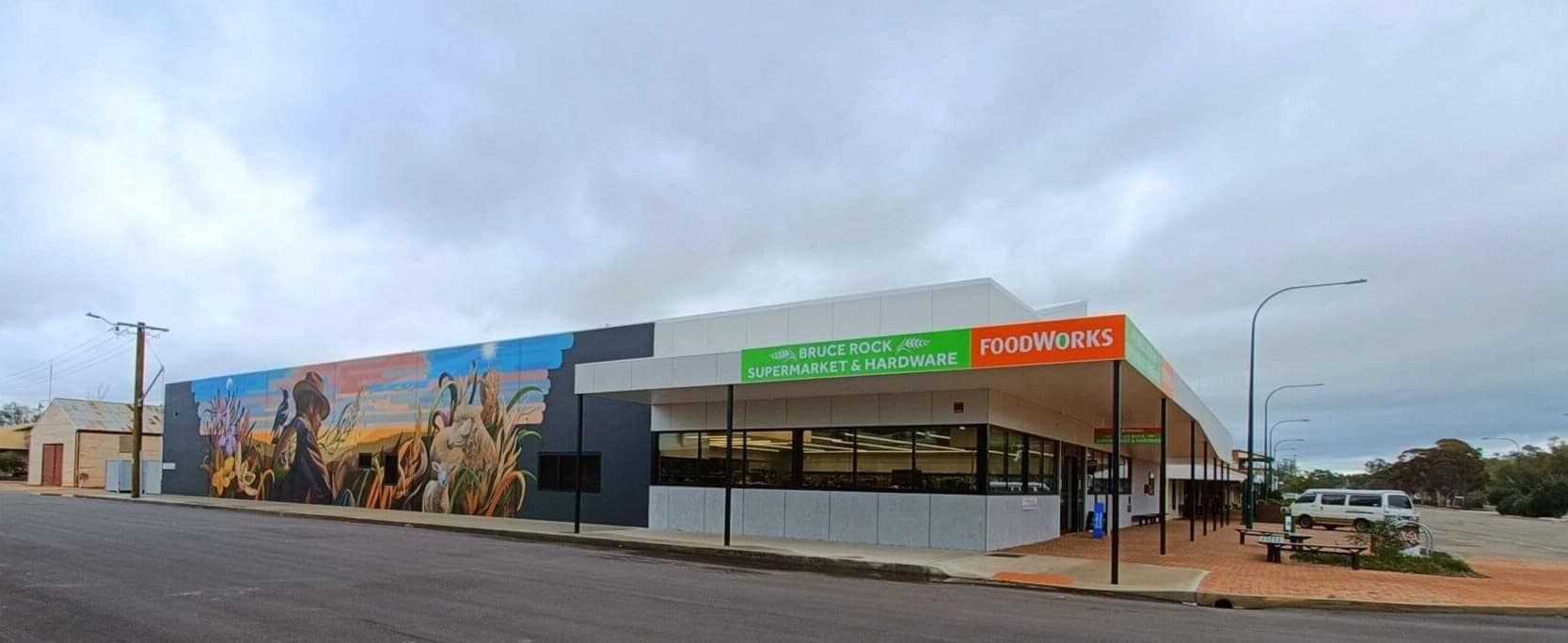
Designing Around a Town’s Everyday Life
Each of those decisions responds to how the building will be used every day.
Insulation and daylight. A supermarket carries heavy refrigeration and lighting loads. A well-insulated envelope and good natural light help keep running costs down, which matters for an operator and a Shire that will both live with the building for decades.
Universal accessibility. In a small town, the supermarket serves everyone, including older residents and people with limited mobility. Making access work throughout the building, rather than only at the entry, follows from that.
A continuous awning. Extending the street awning connects the new building to the rest of the shopping street. In a Wheatbelt summer, shade and shelter along the footpath are practical as well as neighbourly.
Room to grow. Allowing for a future tenancy keeps options open if the town’s needs change, without having to alter the core supermarket layout later.

Lessons for Regional Community Buildings
Replacing a building that a town cannot do without is different from a routine commercial project. A few lessons from Bruce Rock apply more widely.
A temporary solution buys time, but a permanent one takes years. Bruce Rock had a working temporary store within a week. The permanent replacement took most of a further three years. Councils facing a similar loss should start planning and fundraising at once, in parallel with the temporary arrangements.
Consult early and in person. A briefing that presents indicative costs and design elements gives the community something concrete to respond to, and helps the project carry local support through a long process.
Design for the operator as well as the community. Locking in a lease before completion helps ensure the layout, services and loading arrangements suit how the space will actually be run.
Build in flexibility. Spare tenancy space and an accessible, adaptable layout are inexpensive to include at the start and expensive to add later.
Not to Be Confused With the 1929 Co-op Store
The supermarket is sometimes mixed up with another Johnson Street building that was rebuilt after a fire: the 1929 District Co-op Store, which replaced a building destroyed in February 1928. It is a separate building, near the supermarket but not adjacent, and it is recorded as a Category 3 place on the Municipal Inventory. The two buildings share only the fact that each was destroyed by fire and each was replaced.
Conclusion
The Bruce Rock Supermarket replaced a service the town could not do without, and it did so after years of planning, consultation and fundraising by the Shire and the community. Its design, from the insulated envelope to the street awning and the seating at the front, reflects the role the building plays in daily life.
Office of Regional Architecture works directly with councils and communities across the Wheatbelt and broader regional WA on community and commercial buildings, including replacement projects like the Bruce Rock Supermarket. If your Shire or community is planning to replace or upgrade an essential building, contact Office of Regional Architecture early, before the brief and budget are locked in.